A home for your voice inside any beat, carved as the song plays, then mastered loud. One plugin on the Stereo Out. Three dials. Eight characters.

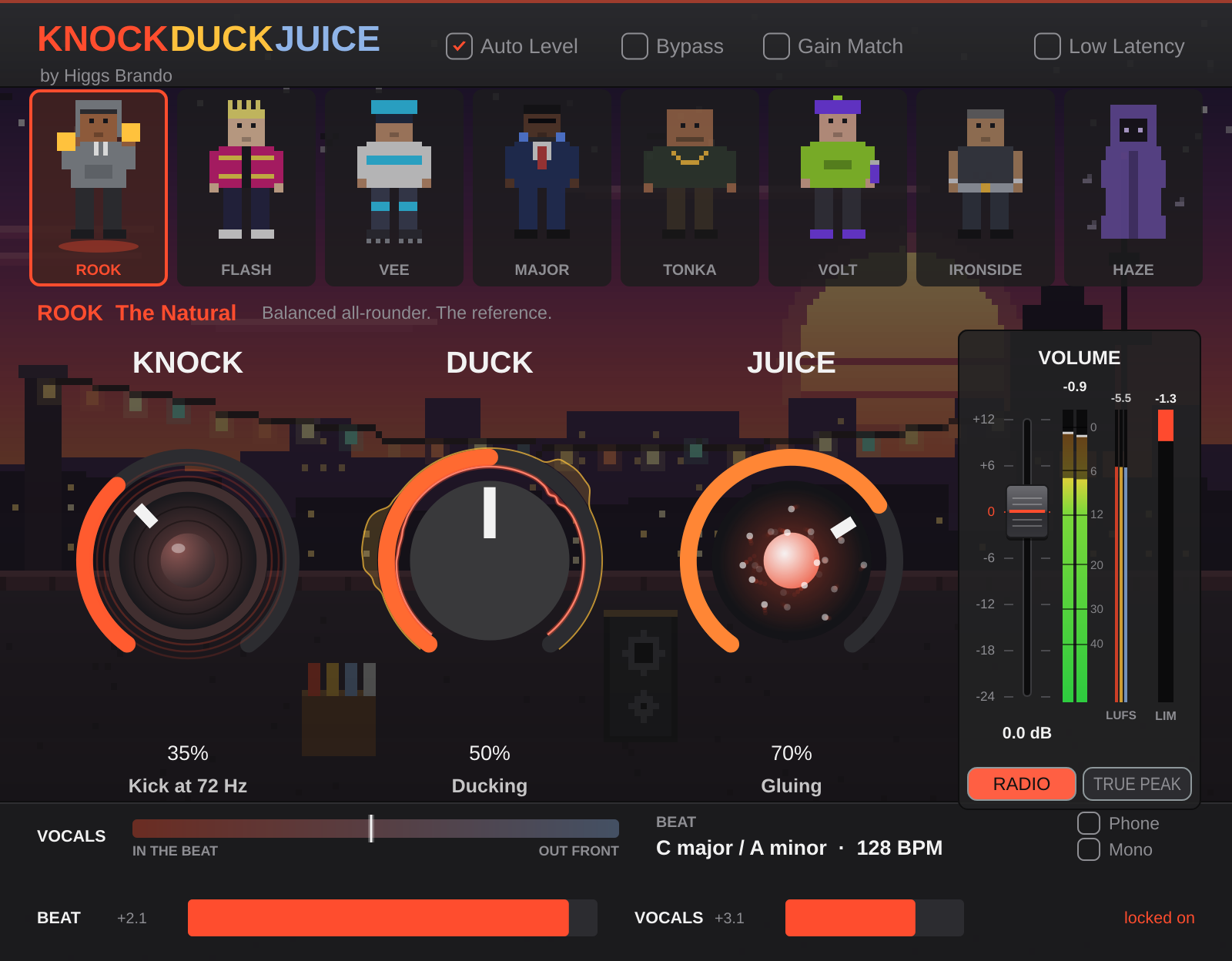
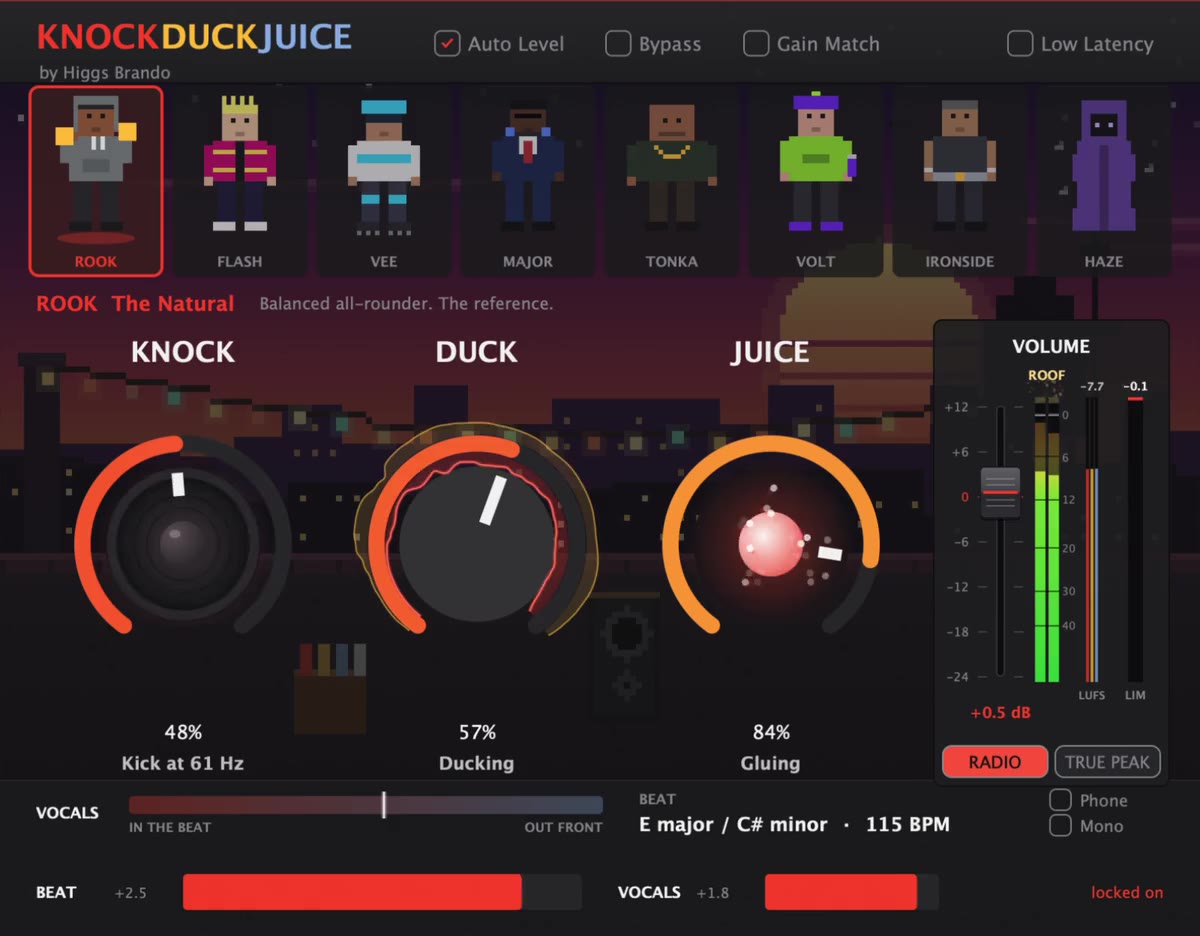
KnockDuckJuice sits on your Stereo Out, with your vocal sent to its side chain. As the song plays it listens to both, and wherever the beat crowds your voice it carves out room, only in the frequencies that clash and only for as long as they clash. The beat keeps its low end and its space, and your voice gets its place. Then the whole song is mastered loud, together.
No stems, no bus routing, no chain of ten plugins. Three dials and a character.
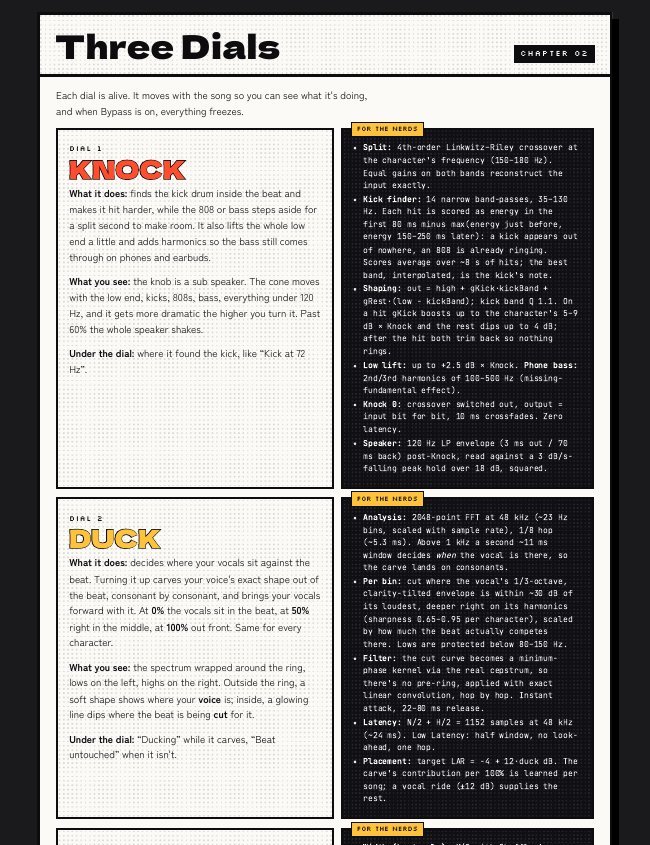
Pitch-tracked transient shaping: a bank of fourteen narrow filters listens to every low-end hit and learns which note your kick is tuned to. On each kick, that note punches forward while the 808 steps aside for a few tens of milliseconds, then both settle so nothing rings. Psychoacoustic bass adds the harmonics your ear uses to hear low notes, so the kick and 808 still come through on phones and earbuds. At 0% the low end is untouched, bit for bit.
Dynamic spectral unmasking: sidechain ducking across a thousand bands, re-decided about 190 times a second. Wherever your voice is right now, the beat steps back exactly there, only as far as it's in the way, and swings straight back the moment you stop. A held note gets a soft pocket, a “t” gets a quick, narrow one. 0% sits the vocals in the beat, 50% in the middle, 100% out front. Same for every character.
Program-adaptive bus processing: glue compression whose threshold follows the song's own level, so it grips the quiet verse and the loud hook the same way. Saturation in the character's flavour, oversampled and kept off the low end. Stereo width on the beat only, never your vocal, and a de-esser that listens to your voice alone. Its makeup gain is predicted instead of waited for, so every turn of the dial is louder and denser straight away, and the limiters below catch the peaks.
A real session in Logic: a beat, a vocal and KnockDuckJuice on the Stereo Out. Play it, then flip Bypass back and forth while the song keeps going, with the plugin's screen moving along.
Listen now
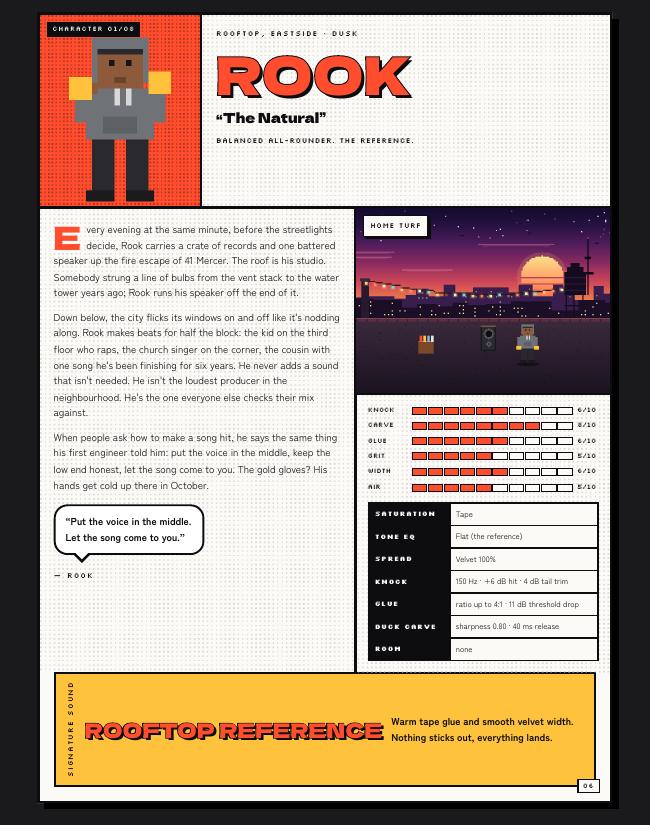
Eight underground musicians, each with a neighbourhood, a saturation flavour, a kick, a glue and a carve of their own. Same three dials, eight different records. Every character is always on, so flipping Bypass always tells you something.
The last thing your song passes through is a full mastering chain, the kind that usually takes a rack of separate plugins and an engineer to set up. Here it's one signal path, tuned by your character, driven by Juice, and listening to your vocal the whole way.
Only the beat gets wider, so your vocal stays dead centre. Each character blends two kinds of spread: airy velvet-noise decorrelation and a bigger Haas delay. The low end stays mono, drum hits stay tight, and folded to mono the song adds back up to exactly the original.
Pulls the beat and your voice into one record. Its makeup gain is predicted from the song's own level history, so turning Juice never pumps or waits.
Tape, dual triode, transistor or clean, in the character's flavour. It warms everything above the low end and leaves the sub untouched.
Listens to your voice alone, so it softens your “s” without dulling the hi-hats.
Brings it up to full level and holds the ceiling, between the samples too.
A second full limiter in two smooth stages for the extra density of a record on the radio. On by default; one click to compare.
Auto Level gain-stages the beat and your vocal in the first seconds you play, so every character starts in the right place, whatever you feed it.
On the Volume fader, 0 is the point where the limiter just starts working, for every song and every character. Push past it for louder, pull back for more air.
Gain Match compares by BS.1770 loudness, the same measure streaming services use, so Bypass shows what the processing changes, not just that it's louder.
True Peak on keeps every peak, including the ones between samples, at −0.1 dBTP. The multimeter shows RMS, peak and LUFS (momentary, short-term and integrated), Logic style.
| Peak with True Peak on | −0.11 dBTP |
| Peak with True Peak off | 0.00 dBFS |
| Limiting at Volume 0 | ≤ 1.9 dB |
| Level jump when Juice moves mid-song | ±0.3 dB |
| Bypass vs the original | 6×10⁻⁸ |
Offline renders of a 40-second test song at 44.1 kHz. Limiting is the 90th percentile. Your songs will vary.
Put KnockDuckJuice on your Stereo Out (the master). Beat and vocal both go through it as usual.
In the plugin header, pick your vocal track in Side Chain. That's how it tells your voice from the beat.
Pick a character, turn the dials. Auto Level sets the volume for you in the first few seconds; Gain Match keeps Bypass a fair comparison.
Ozone-style true peak at −0.1 dBTP, or plain 0.0 peak with it off.
Sets the volume for every character so 0 starts just on the roof.
Bypass is level-matched, so you hear what the dials change.
Shows where your vocals sit, from in the beat to out front.
Reads the beat's key and tempo while it plays.
Hear the song on a phone speaker, or folded to mono.
RMS, peak and LUFS (momentary, short-term, integrated), Logic style.
A lighter mode for recording through the plugin.
A 19-page comic-book manual comes with every copy: the story of every character, the dials explained, the whole signal path, lab results and the research behind it. Every pixel drawn in code.
| Formats | Audio Unit (Logic Pro, GarageBand) and VST3 |
| System | macOS 11 or later · Apple Silicon and Intel (universal) |
| Needs | A host that lets you pick a side chain on the master |
| Latency | About 39 ms (16 ms in Low Latency) at 44.1 kHz, compensated by the host |
| Output | −0.1 dBTP true peak, or 0.0 dBFS peak |
| Windows | Not yet |
Yes. KnockDuckJuice hears the vocal through the side chain, so it can tell your voice apart from the beat. Everything else plays through the Stereo Out as normal.
Yes. It works on whatever reaches the Stereo Out: a 2-track beat, stems, or a full session.
No machine-learning models and no cloud. It's hand-written signal processing that runs in real time on your computer.
The plugin asks for a license key. Buy, paste the key in, and you're back exactly where you left off.
It's measuring how your vocal lines up with the mix. That takes a moment after you press play, or while the vocal is silent. If it keeps saying it, check that your vocal track is picked in Side Chain.
Checkout isn't connected yet. Check back soon.